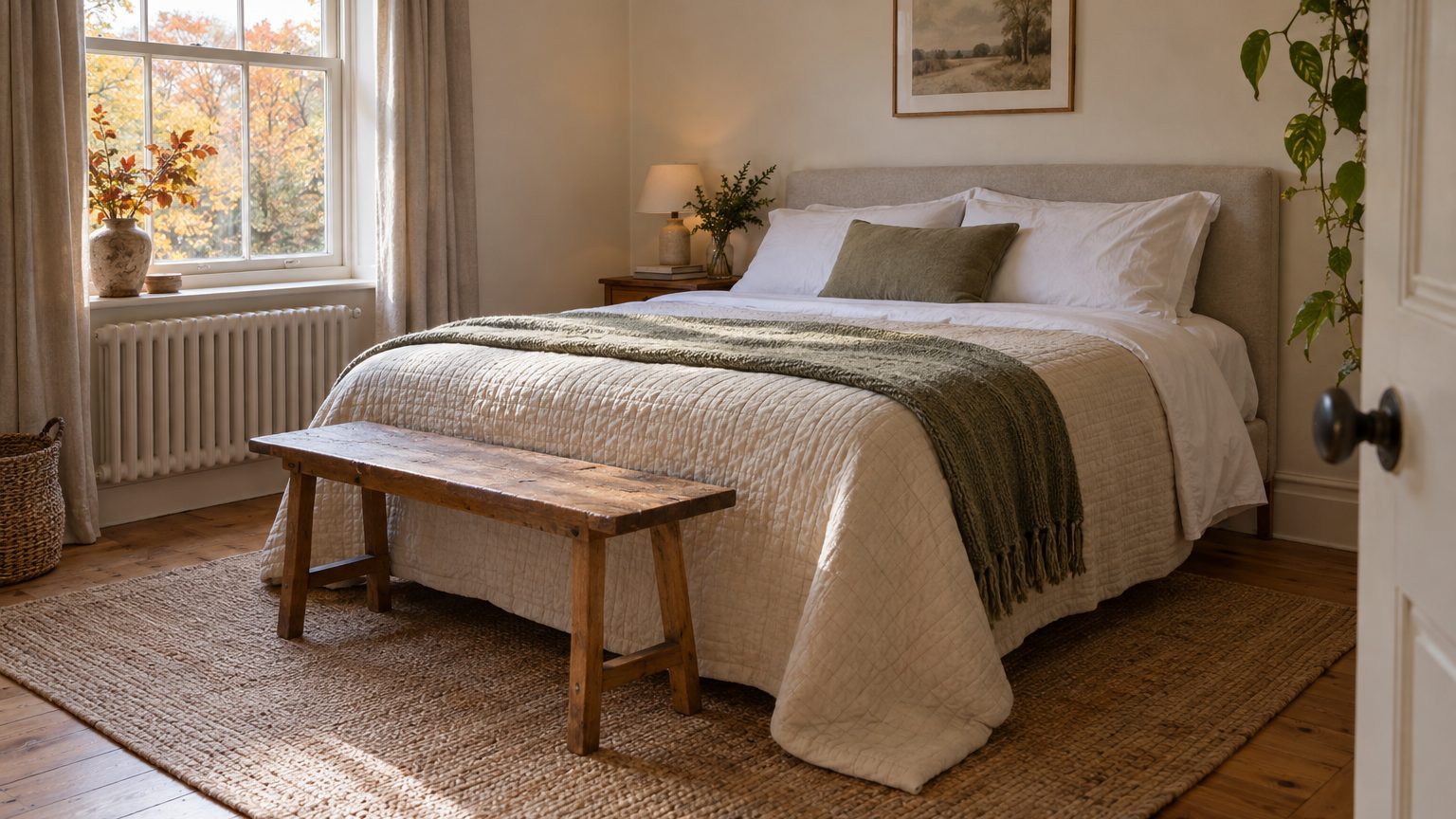
Most guest room ideas on a budget start with decor, and that’s backward. A visitor will forgive a bare wall but not a cold, lumpy bed at 2 a.m. The Sleep Foundation puts a comfortable bedroom temperature somewhere between 60 and 71 degrees Fahrenheit, a range most spare rooms can reach with a little help.
So put your money in the bed first.
- A thick duvet from your own linen closet can do more for a cold guest than a new mattress.
- Adding an extra throw at the foot of the bed lets a cold sleeper warm up without searching.
- Under-bed bins with clear lids let guests find spare linens without asking.
- A few hotel-style extras like a hair dryer, tissues and eye masks cost under a dollar store trip.
Put the budget into the bed
The spare room is often the coldest one in the house, because nobody heats it. A study on duvet warmth, summarized by the Sleep Foundation, found that with a thinner duvet, people needed the room to be 62 to 72 degrees to feel comfortable. With a heavier one, sleepers were comfortable in rooms that varied by as much as 18 degrees. A thick duvet from your own linen closet can do more for a December guest than a new mattress.
Layering does the rest. Use a fitted sheet, a flat sheet and a quilt, then add an extra throw at the foot of the bed so a cold sleeper can reach for warmth without hunting for it. If the bed is a pullout or an air mattress, a padded cover matters even more, and one hosting blogger calls it especially critical for air beds.
Breathable fabric helps too. Cotton breathes easier than polyester, so a set of plain cotton sheets beats a fancy synthetic one at any price. Wash them the day your last visitor leaves and remake the bed. Then, as one budget-hosting writer points out, the bed is always ready, even for spur of the moment guests.
Layers first, throw pillows never.
Borrow furniture from the rest of the house
A guest room needs fewer pieces than you’d think. A sturdy bench, an ottoman or even storage boxes with a blanket can serve as a luggage rack, and the same bench works as a spot to sit and put on shoes. For a nightstand, one host used an old TV tray for years and notes that thrift stores sell them for a few dollars. A side table from the living room works just as well for a week.
Storage is where guests feel the difference between “tolerated” and “welcomed.” Wall hooks handle coats, bags and bathrobes, and hangers plus a few empty shelves or drawers let people unpack instead of living out of a suitcase. Even when the guest sleeps on a couch, you can clear one bathroom drawer, even if you have to dump your own things into a bag for the week.
Floor space tends to be the real constraint. Under-bed bins hold spare linens, and clear ones let a guest see what’s inside without asking. Plug-in wall sconces free up table space and give focused reading light, which solves the problem of tiny nightstands. A mirror hung behind the door or over the dresser lets someone get ready without tying up the only bathroom at 7 a.m.
None of this requires a trip to a furniture store.
No spare room at all? Then borrow a corner of the office or living room. Keep the guest kit (linens, a lamp, a basket) in a closet and set it up when needed. As one host who went years without a dedicated room puts it, any space can be made guest-friendly with clean linens, cozy touches and a welcome basket.
Hotel touches that cost almost nothing
Hotels charge for comfort, but the details that make a stay feel considered are cheap. One holiday-hosting guide suggests treating the room like an Airbnb listing: a printed Wi-Fi password, a stack of local magazines, or a bedside carafe of water. Add a basket of towels, toiletries and snacks, and a handwritten note. The whole kit costs less than one night in a mid-range hotel.
Test it yourself before anyone arrives. Costco’s guest room advice includes a simple trick: spend a night in the room a week before, which helps you pinpoint what else is needed. You’ll find the lamp that’s too far from the bed, the outlet behind the dresser, the draft from the window.
Then fill the gaps with small things. A hair dryer saves a guest from having to ask for one. Put a box of tissues and a small wastebasket in the room. A couple of pain reliever and antacid packets suit the morning after a long holiday dinner, and eye masks and bottled water cover the rest. Buy them at a dollar store, and nobody will know.
Holiday flair can come almost free as well. Forage for branches, pinecones or citrus for a dresser display, or frame free printables as seasonal art. Thrift and vintage shops sell ornaments and candlesticks for a fraction of the cost of big stores. A holiday-scented candle, or a flameless one if you’d rather not leave a flame burning, finishes the room.
Check the temperature, light and air before they do
Winter adds a few jobs. Trane, citing the Sleep Foundation, suggests keeping nighttime temperatures 2 to 5 degrees cooler than the daytime or evening temperature, and a good indoor humidity level of between 30% and 50%. For a drafty room, Costco recommends a mobile space heater. Pair it with extra blankets and pillows within reach so nobody has to wander the house at night.
Light deserves the same attention. Bedside lamps give focused, gentle light for reading, and a dimmer on the overhead fixture makes the room more adaptable. Pull the bed away from the wall if the layout allows, so two people can get in and out on their own sides.
One last point if the visitors are grandparents: research summarized by Sleep World suggests that people 65 and older may sleep better in a slightly warmer room, between 68 and 77 degrees Fahrenheit. A thermostat nudge for them costs nothing.
Sources : jillianlare.com | trane.com