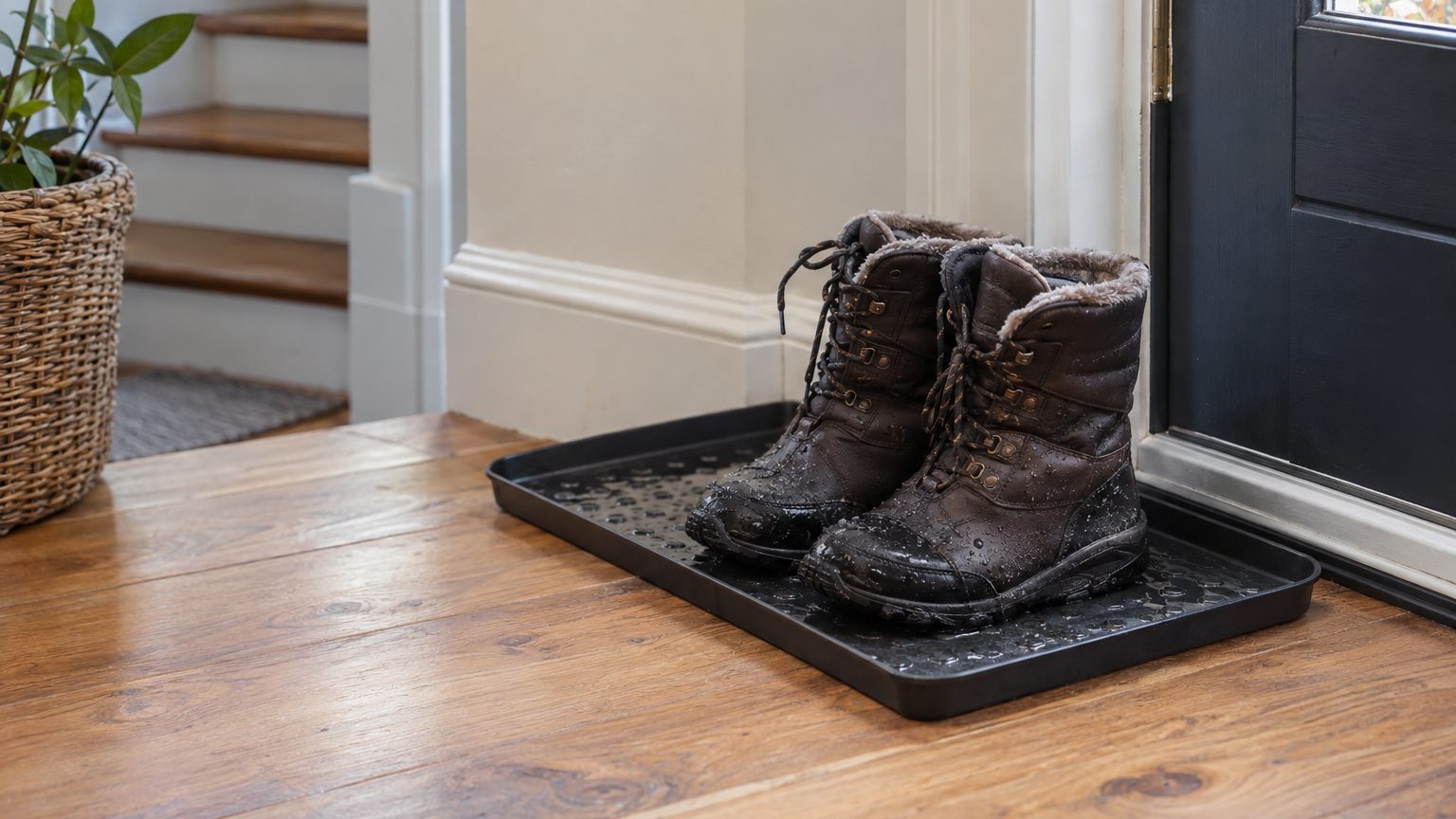
One pair of snowy boots can leave a puddle of grey meltwater, grit and road salt spreading across the floor within an hour. On hardwood it leaves white salt rings and can lift the finish. On tile it turns the grout dark. A tray stops most of that, as long as you pick the right one and put it in the right spot.
- A raised rim of about 1.2 inches holds more slush than a 0.8-inch rubber rim.
- A removable coir or ribbed insert keeps boots raised above collected moisture.
- Empty and rinse the tray every two to three days during active winter months.
What salt actually does to your floor
Rock salt and other ice-melting compounds are highly abrasive, and on hardwood they act like sandpaper under the weight of heavy boots. Every step grinds the crystals into the finish, leaving microscopic scratches that dull the surface over time.
Other floors don’t escape. Constant exposure to road salt can wear away the waterproof layers on laminate, which opens the surface to stains, moisture damage and mold. Tile is water-resistant, but under continuous exposure evaporation may fall behind, and moisture can seep down toward the wood subfloor.
Salt residue is sticky, so it also attracts more dirt.
That is why prevention beats cleanup. Salt is alkaline, so ordinary neutral-pH cleaners tend to spread it around instead of dissolving it. A tray catches the water where it drips, before it can travel. Outside the door, a stiff-bristled mat does the first pass, because a heavy-duty coir or rubber mat is built to scrape chunks of snow, mud and rock salt off boot treads.
Boot tray ideas that start with the rim
Height of the edge matters more than looks. Look for a raised edge and a non-slip base, and empty the tray promptly. Rim heights vary: one multi-purpose tray has a 1.2-inch edge, taller than rubber trays with 0.8-inch rims. A deeper rim holds more slush, which counts on a day when the whole family comes home at once.
Material is a trade-off. Rubber resists cracking and stays flat underfoot. Metal trays can have deeper walls (one steel model has a 2-inch rim), but steel is noisier and less forgiving than rubber if someone steps on the rim, and it doesn’t roll up for storage. Galvanizing and powder coating resist rust, but salt water left standing for days is hard on any metal finish.
Size comes down to counting boots, not square footage. One retail rubber tray with a coir insert is described as holding two to four pairs of adult boots. A family of five with a dog needs a longer tray, or two trays, and the same goes for anyone who keeps ski boots by the door.
Here is the weakness of every tray: it holds water but doesn’t get rid of it, so boots can end up sitting in a cold puddle. One fix is to line the tray with pebbles or a ribbed insert so boots stay raised above the collected moisture. River stones are an easy upgrade (a layer of them also looks good). A removable coir insert does the same job, and it can be shaken out, hosed down and air-dried.
Placing it so it protects the floor
Put it where the boots come off, not where you wish they would. In most homes that means directly inside the door, within one step of the threshold. One owner whose tray sits just inside the back door says it saves her from mopping several times a day.
Pair the tray with somewhere to sit. A narrow bench above it lets people unlace boots over the tray and not over the floorboards, so drips fall where you want them. Hooks at head height keep wet coats from dripping onto the tray’s edge.
Skip the rug. On a rug, meltwater soaks straight in. If your only open floor is carpeted, set the tray on a hard surface such as a waterproof mat, and on heavy days put a towel under it. The towel catches slosh from tipped boots and the occasional overflow, and it goes in the wash at week’s end.
Consider a no-shoes rule for winter, too. It can sharply cut wear on entryway floors, and offering slippers keeps guests comfortable. A basket of slippers beside the tray makes the rule feel like hospitality instead of a lecture.
Keep the route clear.
Keeping the tray from becoming the problem
A neglected tray turns into a salt bath. One review site recommends that, during active winter months, you empty and rinse the tray every two to three days to prevent salt buildup and mold. Road salt left in standing water gets more concentrated and more corrosive. Pour the water outside, away from the house, and not down a floor drain you care about.
The floor around the tray still needs a daily glance. Wiping entryway floors daily in winter removes salt and moisture before they settle. Sweep or vacuum first so loose crystals don’t scratch the finish as you wipe. Tile owners can also look at their grout: sealing it helps it keep its color and prevents darkened patches around doorways.
What you’re fighting depends on where you live. In parts of Colorado, for instance, the de-icer is magnesium chloride, which pulls moisture from the air. It can draw water out of the air at 33 percent relative humidity or higher, so the residue stays damp. Check what your town spreads on its roads, because a tray that gets emptied and dried often matters even more with a product that never fully dries.
Sources : amazing-maids.com | aol.com